- SEO slug
- iran-israel-war-impact-on-global-logistics
- Meta description
- The Iran–Israel conflict is disrupting airspace, shipping, cargo capacity and transit planning. Veer-Freight explains the decisions importers need to make.
- Primary audience
- Importers, exporters, mining, manufacturing, construction, engineering and agriculture
Executive takeaway
The decisive risk is not distance; it is network dependency. A route can look open on a map while the aircraft rotation, port call, feeder link or insurance cover behind it has already changed.
From regional conflict to network-wide disruption
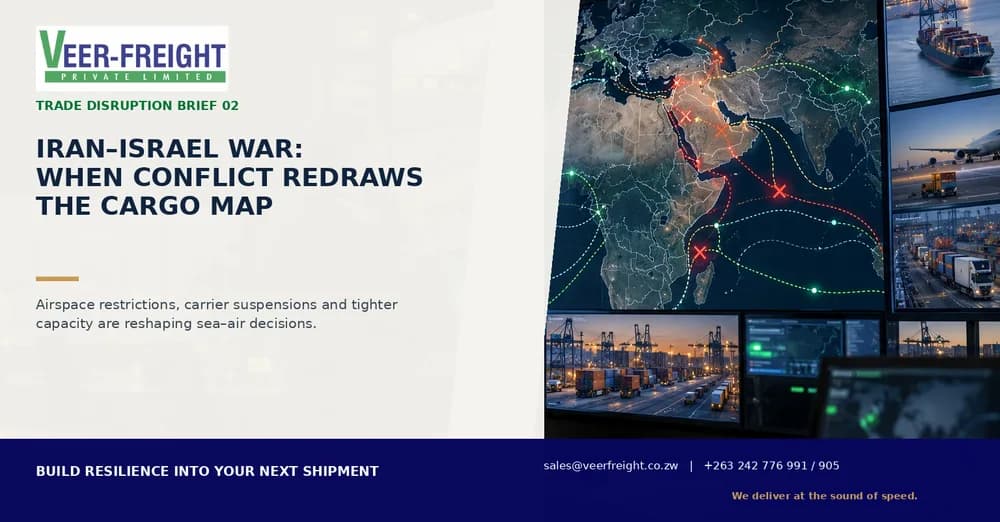
The conflict that began with U.S. and Israeli strikes on Iran on 28 February 2026 has moved far beyond a bilateral headline. It has affected energy infrastructure, commercial shipping, regional airspace and the operating confidence of carriers. The result is a multi-modal disruption in which ocean, air and road networks are adapting at the same time.
When several modes absorb stress together, substitution becomes harder. Cargo shifted from sea to air competes for limited uplift. Cargo diverted to ports outside the Gulf adds inland distance and border complexity. Aircraft avoiding restricted airspace burn more fuel and lose productive hours. Each protective decision is rational, but the combined effect is higher cost and reduced predictability.
The four pressure points clients should watch
Capacity is the first pressure point. Suspensions, booking stops and revised rotations reduce the space available even on lanes that remain technically open. Transit time is the second: diversions and connection failures create irregular schedules rather than one uniform delay.
The third is price. Security premiums, fuel costs, longer routes and scarce capacity can alter quotations quickly. The fourth is compliance. Sanctions exposure, end-use questions, carrier restrictions and screening requirements can make accurate consignee, commodity and origin information commercially decisive.
What this means for mining, manufacturing and project cargo
For a mine facing a breakdown or a manufacturer protecting a production line, the value of the cargo is often smaller than the value of the downtime it prevents. That changes the routing equation. The correct decision may be to split a consignment, expedite only the critical components and move the balance by a more economical mode.
Project cargo requires an even earlier decision window. Oversized equipment depends on specialist capacity, permits, lifting plans and coordinated hand-offs. If a corridor changes after mobilisation, the cost of recovery can exceed the premium of planning a resilient route from the start.
What good disruption management looks like
A sound response begins with a live route assessment: carrier status, hub exposure, trans-shipment risk, airspace constraints, documentation and fallback options. Quotations should be compared on an all-in basis, including surcharges, likely storage, handling and the cost of delay.
Businesses should also establish decision triggers. At what point should cargo be split? When does an airfreight premium become cheaper than operational downtime? Which destination or gateway can clear the commodity reliably? Clear triggers prevent teams from paying panic prices after options have narrowed.
Veer-Freight: execution under changing conditions
Veer-Freight positions logistics as trade execution, not a booking exercise. We coordinate suppliers, review shipment requirements, validate documents, assess route options, schedule collections and manage clearance through to confirmed delivery.
In volatile markets, visibility is not a tracking link. It is the ability to understand what has changed, what it affects and what decision must be made next. That is the intelligence we bring to every consignment.
Ready to protect your next shipment?
Request a route and cost assessment from Veer-Freight: sales@veerfreight.co.zw | +263 242 776 991 | +263 242 776 905 | veerfreight.co.zw
Sources and editorial note
Market conditions are fluid. Facts and figures below were checked on 8 September 2026. Confirm live carrier acceptance, routing, surcharges and capacity before booking.
Reuters, 7 September 2026
Maersk — Middle East conflict and global supply chains
IATA — Middle East disruptions and airline outlook
Need help with your shipment?
Request a Quote