- SEO slug
- strait-of-hormuz-impact-on-logistics
- Meta description
- The Strait of Hormuz disruption is changing fuel prices, vessel availability, insurance and delivery planning. Here is what regional importers should do now.
- Primary audience
- Importers, exporters, mining, manufacturing, construction, engineering and agriculture
Executive takeaway
The Strait is no longer only a Gulf shipping issue. It is a pricing, capacity and continuity issue for every business buying transport, fuel-sensitive services or goods routed through Asian and Middle Eastern hubs.
A chokepoint with an outsized balance sheet
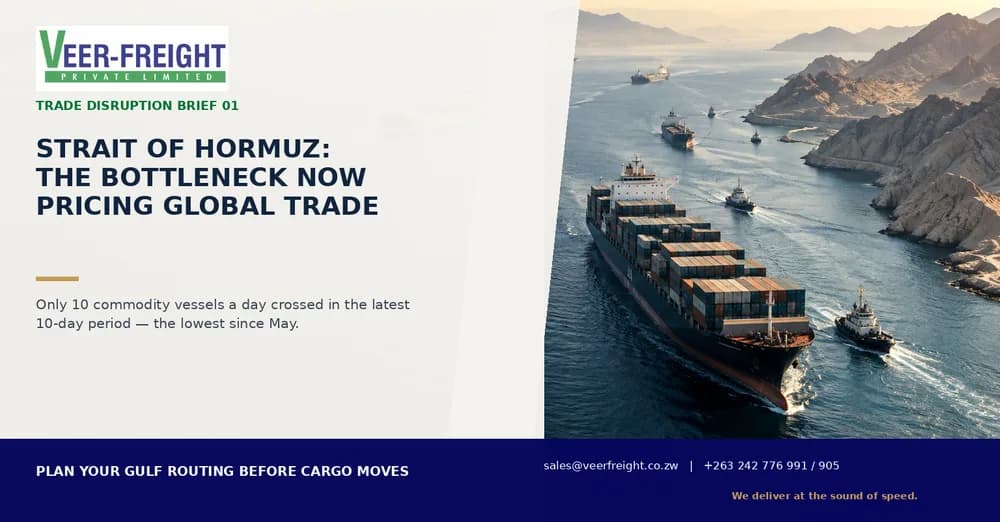
The Strait of Hormuz connects the Persian Gulf to the Gulf of Oman and the Arabian Sea. Before the current war, it carried roughly one fifth of global oil and liquefied natural-gas shipments. The latest reporting on 7 September 2026 showed an average of only 10 commodity vessels per day crossing during the preceding ten days, the lowest level since May. Iran has also signalled a new restricted zone and shipping corridor, adding another layer of operational uncertainty.
That matters because the cost of disruption does not remain at sea. It moves through bunker fuel, war-risk insurance, carrier schedules, equipment availability, port congestion and inventory finance. A shipment that never enters the Gulf may still be quoted against a network absorbing those costs.
What importers and exporters are likely to feel
The first signal is quotation volatility. Ocean rates may remain valid for shorter periods while emergency bunker, congestion or security-related surcharges appear with limited notice. The second is schedule instability: port omissions, suspended bookings, trans-shipment changes and slower equipment repositioning can widen the gap between an advertised and an achievable transit time.
The third impact is working capital. When high-value spares, mining inputs, manufacturing components or agricultural equipment sit longer in transit, cash is tied up while production plans continue to age. A cheaper route can therefore become the more expensive business decision once downtime, demurrage, storage and missed commitments are counted.
The Southern African exposure
For Zimbabwean and regional businesses, the transmission route is often indirect. Cargo sourced from China, India, the UAE or wider Asia can depend on Gulf hubs, feeder networks, energy prices or carrier rotations affected by the Strait. Even shipments routed through ports outside the Gulf can inherit higher fuel and capacity costs as networks rebalance.
The practical question is not simply, ‘Does my vessel pass through Hormuz?’ It is, ‘Which parts of my supplier, carrier, trans-shipment and fuel chain are exposed to the disruption?’
A more resilient operating response
Businesses should map exposure before booking, not after cargo is already committed. Confirm the origin port, trans-shipment points, carrier acceptance status, quote validity, surcharge clauses and the cost of at least one credible alternative. Critical cargo should be ranked by operational consequence so that airfreight, sea–air or alternative-port options are used selectively rather than emotionally.
Documentation readiness also matters. In a constrained network, a missing invoice, permit or packing detail can cause a shipment to lose scarce space and fall into the next disrupted cycle.
How Veer-Freight supports continuity
Veer-Freight coordinates the chain from supplier contact and route assessment through document checks, collection, freight movement, customs clearance and final delivery. Our role is to help clients see the full route, understand the commercial trade-offs and receive stage-based or exception-based updates while conditions change.
The Strait may be narrow. Your options should not be. Speak to Veer-Freight before confirming Gulf-linked cargo so that routing, documentation and contingency decisions are aligned from the start.
Ready to protect your next shipment?
Request a route and cost assessment from Veer-Freight: sales@veerfreight.co.zw | +263 242 776 991 | +263 242 776 905 | veerfreight.co.zw
Sources and editorial note
Market conditions are fluid. Facts and figures below were checked on 8 September 2026. Confirm live carrier acceptance, routing, surcharges and capacity before booking.
Reuters, 7 September 2026
U.S. Energy Information Administration — World Oil Transit Chokepoints
UNCTAD — Strait of Hormuz disruptions
Maersk — Middle East conflict and global supply chains
Need help with your shipment?
Request a Quote